Into the Camp
“Escuelita.” The word sounded familiar but I had trouble understanding when the small children spoke.
Now they were grouped in front of me. Three serious little boys in dusty pants and a tiny girl with a tangle of dark hair. With them was Elias’ wife Belén . . . slender, graceful Belén with the deep brown eyes and the golden skin. She held her baby in a pink blanket.
“Teacher,” Belén said, “they want an escuelita, a little school. You teach the big people. The little ones want you to teach them, too,”
“Escuelita,” echoed the little ones.
“Yes, of course,” I said. “We must have a school for the children.”
That night when I returned to the Presbyterian parsonage, I used the phone to call my sister.
“June?”
“Hello. How are your classes going at the migrant camp?”
“Fine, but I have a question to ask. Do you remember when we were in high school, how we talked about becoming missionaries?”
“Yes. We had some wild daydreams about taking a steamer to India where we bandaged lepers . . .”
“And started an orphanage for abandoned babies.”
“We planned to bring the good news to the uttermost parts of the world, so we went by train to China.”
“And we had to dress in padded clothes because of the cold winds from Tibet.”
I heard June giggle as she remembered our fantasies. “Of course we were fluent in a Chinese language so we could teach Bible school to the children.”
“June, the children at the migrant camp want a little school.”
“A Bible school?”
“What do you think? Could you and I have a mission Bible school right here in the Willamette Valley?”
“We could use a flannelgraph to tell stories.”
“For music I have a guitar.”
“And I have an accordion.”
“I’m going home for the weekend. If you could be ready, I’ll pick you up Monday morning.”
“I’ll have to get a woman to cook for my family.” June’s voice was briefly hesitant, “but I’ll find someone and be ready Monday morning.”
“Good! I’ll see you then.”
“Wait. Where will we stay?”
“I’m here at the Presbyterian parsonage. Maybe there’s room for both of us.”
“Could we accomplish more if we lived in the migrant camp?”
“In the camp? June, you don’t realize . . .”
“We would be right there to teach the Bible school and I could help you with English classes in the evening.”
“I’m not sure.” I thought of the dingy rooms and the outdoor toilets.
“We could have a library of books for the children in our room. I’ll go to our elementary school and ask for books.”
I began to catch June’s enthusiasm. “We could cook pinto beans and learn to make tortillas.”
It began to sound like a possibility.
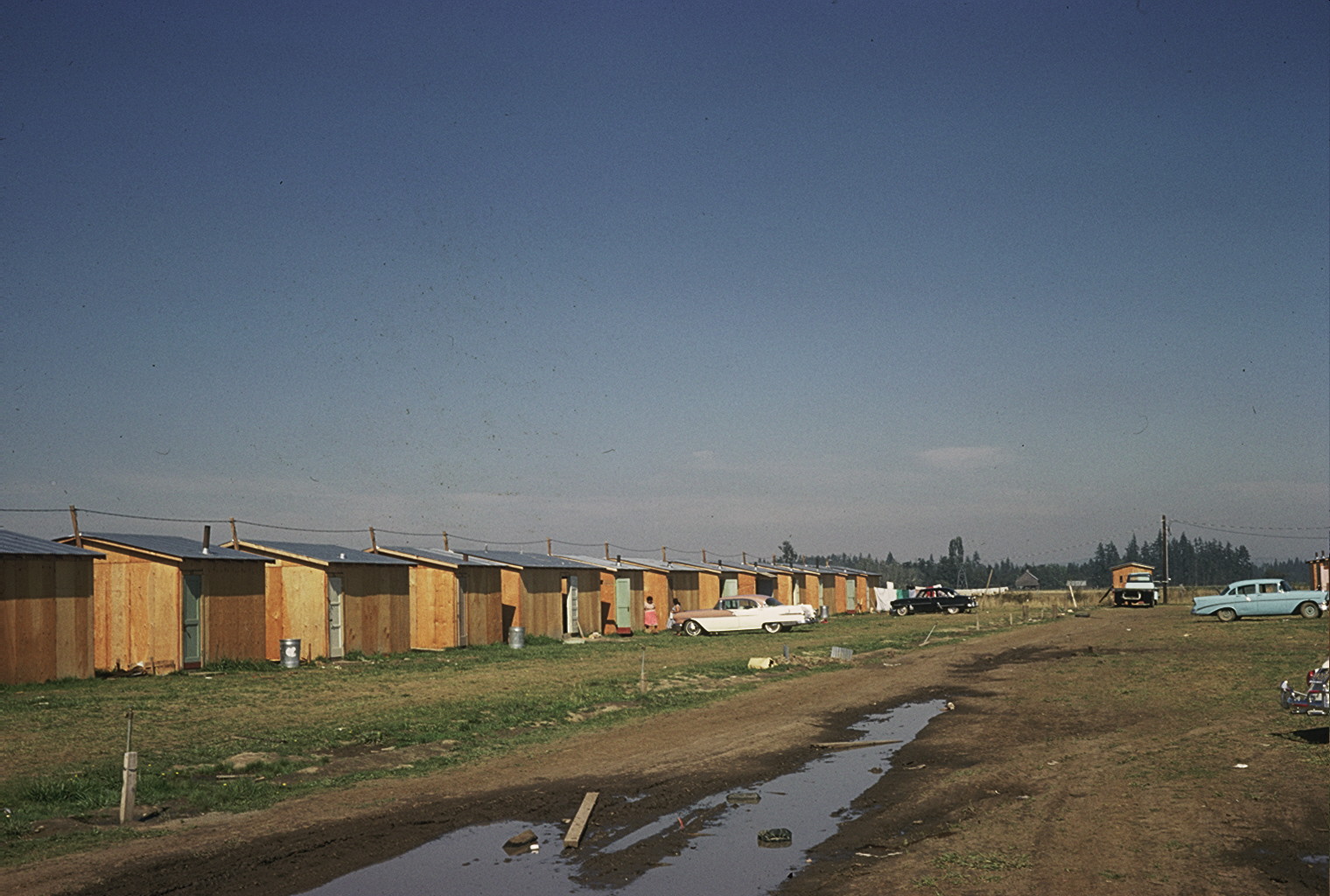
On Monday morning I drove to June’s house and by noon we arrived at the migrant camp, a good time to find the owner of the farm so we could ask for a place to stay. One entire building was empty.
“I don’t have anything to do with housing,” said the owner. “You’ll have to ask the labor contractor.”
“No place,” said the contractor as June and I stood in front of a row of empty rooms.
“I’m expecting eighty more workers from the Yakima Valley. They’ve been up there cutting asparagus and now I need them here in the strawberries. My brother is bringing them down tonight or tomorrow. Even my family is up there and they are coming, too.”
June and I had counted fifty-two empty living quarters so we weren’t planning to give up so easily.
“I guess the workers don’t need that many rooms,” I said.
“There is no place in this camp for you.” The contractor walked away.
“How come he’s so unfriendly?” June asked.
“Maybe if the workers know how to speak English, they might not need a contractor.”
Domingo’s wife Rosalia stood in her doorway. I glanced back at June and realize what a contrast we were to the workers. Most of the women had brown skin and long, dark hair. June’s blue eyes and curly blond hair went well with her light skin, but in the camp we must have appeared pale and colorless to the migrants.
Although June was only five feet five inches, she was taller than the women in the camp, and I was five feet seven inches. Occasionally my students referred to me as La Alta, the tall one.
Rosalia watched the contractor leave. When he was out of sight, she came to June and me.
“I think you can stay at the next farm. The grower’s camp is empty and he won’t have workers until next month. He has green beans not strawberries.”
“Will you go with us to ask him?”
“It’s just across a small field.”
The grower was friendly. “Sure, you can stay. There are eighty-six rooms, all empty. Choose the one you want and I’ll have my hired man bring in mattresses from the barn.”
We drove our car into the empty camp. Rain started to fall as we unpacked.
“At least we have a roof over our heads and we are in a labor camp,” said June, “although there aren’t any workers here.”
“And we found a room with a window even though it’s only two feet square.” I looked at the dirty panes of g1ass. Most of the rooms had a plastic-covered hole in the wall instead of a glass window
“We have a cook stove.” June opened the lid and looked inside.
“But no stovepipe.” I said.
We put on rain jackets and boots before we went out to hunt for a stovepipe. We removed one from a stove in another room and carried the sooty pieces to our stove. We poked the pipe up through the hole in the metal roof and fastened the bottom section to our stove top.
June carried a bucket of water from the outside tap so we could wash our hands.
That night after the first day of our little Bible School and after the English class, we returned to our room and climbed onto the rough boards and old mattresses that served as bunk beds. Our door was fastened with only a fragile piece of shingle and a small nail against the dark night and the too-quiet loneliness of the empty living quarters.
“I wish we were sleeping near our students at Harvest Valley Farm,” June said.
The sound of tiny claws rattled on the corrugated metal roof two feet above my head.
“Rats or mice?” I asked.
“Mice, of course,” came June’s muffled answer as she huddled under blankets in the lower bunk.
We knew they were rats and that they would soon enter the room to rummage through our food boxes.
“I hear grains of rice falling on the floor, and I think our cookies are being eaten.”
“I’m scared to get up and look.”
“Remember how we daydreamed about going to Africa?”
“We paddled a boat up a muddy river and a crocodile attacked us, but we made it safely to the village.”
“We were so brave,”
“The first night in the village, a boa constrictor entered our hut, but we chased it out the door.”
We listened to the sound of rats chewing through paper and plastic. The rest of the camp was silent as eighty-five other rooms stood empty and still.
Morning seemed a long time away.
* * *
Copyright 2012, Rolf Erickson