The Little School
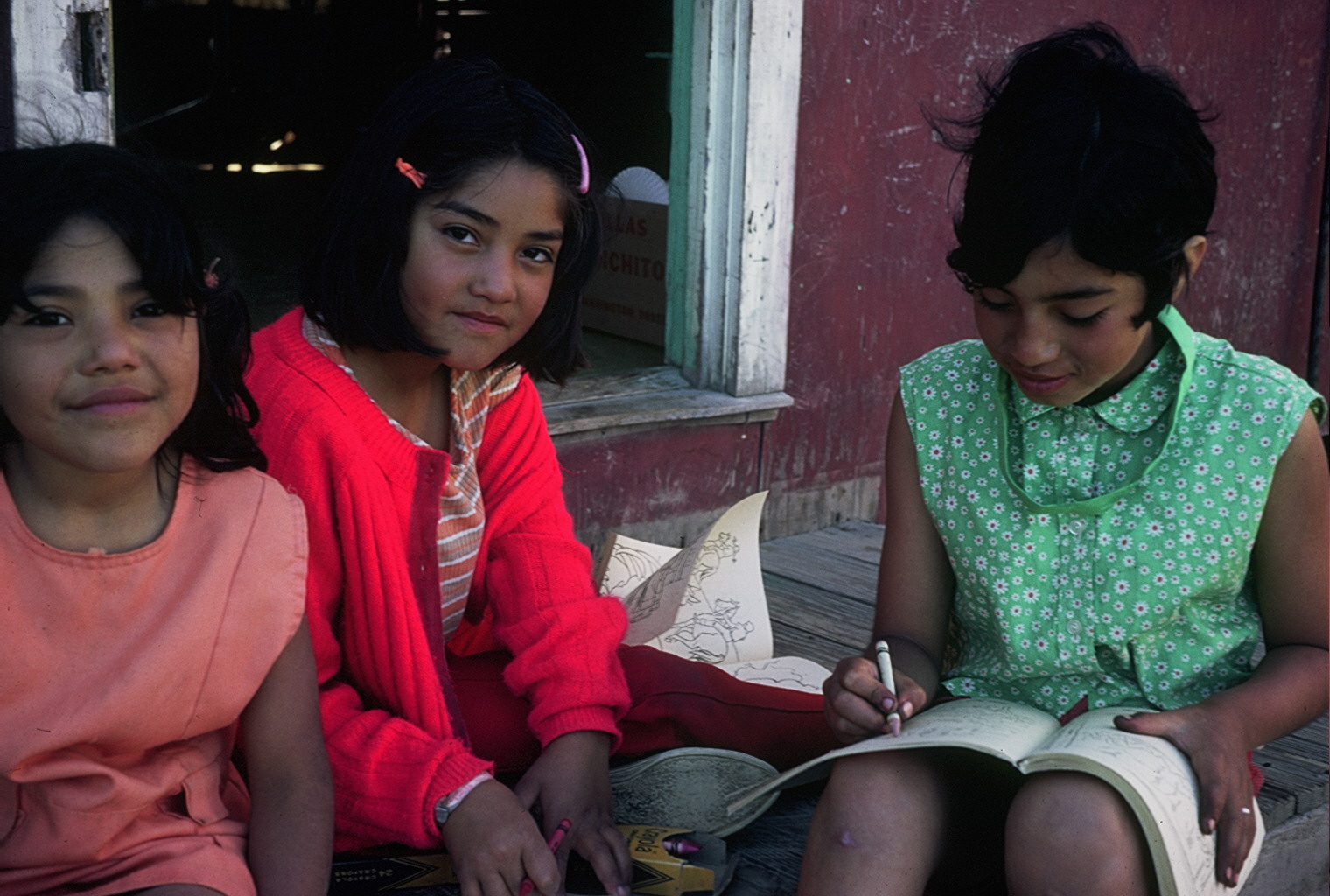
The next afternoon forty children crowded into the school room.
Little dark-eyed girls shivered in thin dresses. Older girls carried babies that had been left in their care by tired mothers. Little boys jostled each other, and shy, quiet bigger boys asked if they were too old for the escuelita.
Our school was a room at Harvest Valley Labor Camp. June and I had decided to avoid the unfriendly labor contractor and hope he wouldn’t notice that we were using an empty housing unit. If he told us to leave, we would have to go. He had the power to crush our teaching efforts.
I was trying to coax a fire to burn in the reluctant stove. The wood was wet and as I blew on it, smoke choked me. The room was cold and damp.
June had already swept out yesterday’s mud, and now the children came to sit on narrow benches that we had borrowed from their mothers and on an old, bare bed spring. When these were full, they sat on pieces of firewood from the woodpile.
I thought back to the day before when we had gathered the children for their first session at our Bible school. At four in the afternoon when the children had come from working in the fields, June and I stepped around mud puddles as we walked through the camp. June played her accordion and I followed along strumming my guitar.
Valiantly I played the three chords that I knew and warbled a low-pitched version of “El Rancho Grande.” It had to be low-pitched to go with my three chords, and it had to be “El Rancho Grande” because that was the only song I knew in Spanish.
Rosalia waved to us and watched as little Delia ran to join the group of children that were following us.
We led them to our school room but about half had no place to sit.
“Bueno, well, you could sit on the floor,” I said.
They looked at the wet boards where muddy water dripped from their bare feet and at lumps of cold mud that had been tracked in by those with shoes. The children stood. Later I learned it is not the custom to sit on the floor.
Since June didn’t speak Spanish, she taught songs and finger plays in English. I translated into Spanish, “This is the church; this is the steeple . . .”
Belén came into the room and stood at the back, holding her baby nestled on her shoulder.
Using a flannelgraph, bright pictures that I placed on a flannel-covered board, I told the story of the Good Samaritan, We colored with crayons and then it was time to stop for that day.
“Teacher, will you come tomorrow?”
I stooped down so I could look into Delia’s serious face.
“Si, niña, yes, little one. We will come tomorrow and the next day and the next, every day this week.”
Now it was the second day. During the morning June and I had gone to a supermarket and asked for cardboard cartons. We needed them for playpens and beds for the babies.
At last fire burned in the stove and outside the sun came through the clouds. Our classroom seemed brighter and warmer than the day before.
I put a picture of a lamb on the flannelboard and turned to smile at the children.
Delia’s brother Carlos was looking out the door. He jumped up and shouted the Spanish equivalent of, “Jiggers, the priest!” About half of the children rushed out the door and scattered around corners of buildings and behind bushes.
I looked out and saw a dark-haired young man in a black suit and clerical collar.
“What explosion was this?” he asked in Spanish.
“I suppose they thought it wise to leave since my sister and I are Protestants. We are Lutherans.” I said what I was thinking before I stopped to evaluate how it might sound to a priest.
“What are you teaching them?”
“Bible stories. Today we have the Good Shepherd. Would you like to come in and see the flannelgraph?”
“Beautiful,” he said as he touched a picture of a lamb. “The pictures are wonderful.”
I tried to sound matter-of-fact as I asked, “Are you planning Bible classes for the children?”
“No, I came from Mexico to teach confirmation, to baptize, perform weddings, celebrate Mass in the camps, and to bless cars and trucks. I won’t have time to teach Bible school.”
Inwardly I sighed with relief. Our little school was safe.
The children had come near to listen.
Come, children,” said the priest, “the lady will tell you a story about Jesus, the Good Shepherd. Come, come, it’s all right.”
He turned to me. “Some other day perhaps I can hear one of the stories, but now I have promised to bless a pickup truck and it’s waiting for me.”
The children settled again onto the benches, firewood, and bed spring. They sat quietly as I told the story of the Good Shepherd.
For the moment, at least, all was in harmony.
The children had the little school. June and I had our mission. The priest had a pickup truck to bless.
* * *
Copyright 2012, Rolf Erickson