My Name Is Luisa
 My car bumped down the gravel road. On either side, acres of strawberry plants drooped in the still evening of the hot June day.
A sign, dimmed by years of sunshine and rain, pointed to a dirt road.
HARVEST VALLEY FARM LABOR CAMP
NO TRESPASSING
Ahead of me the migrant camp was a collection of long, low buildings. Its unpainted boards looked like ancient chicken coops that had been hastily nailed together fifty years before.
When I had agreed to teach English to Spanish-speaking migrants for the Oregon Council of Churches, I hadn’t realized that a migrant camp would look like this.
I began to wonder why I had volunteered. Perhaps I should just return home to my husband, two daughters, and little son. But my family had assured me that they would enjoy taking care of themselves for three weeks, and that Grandmother was looking forward to cooking for them.
They smiled and waved goodbye when I left home to drive the sixty miles to the camp. I couldn’t go home and disappoint Grandmother, and I didn’t want to admit defeat before I even started to teach.
I parked my car by the side of the dusty road and looked again at the camp. Numerous doors in each building led into individual rooms. In some of them I could see women preparing food on rusty, wood-burning stoves.
My heart raced and my hands trembled while I gathered papers and pencils. Should I lock the car or would that appear that I was distrustful of the migrants?
What should I do with my purse? My car keys?
I slid my purse under the front seat, dropped the keys into the pocket of my dress, and left the car windows open.
Little, dark-haired children stopped playing in the dirt to stare at me. They stood in silent groups as I walked toward them I noticed that their hands were stained from picking strawberries.
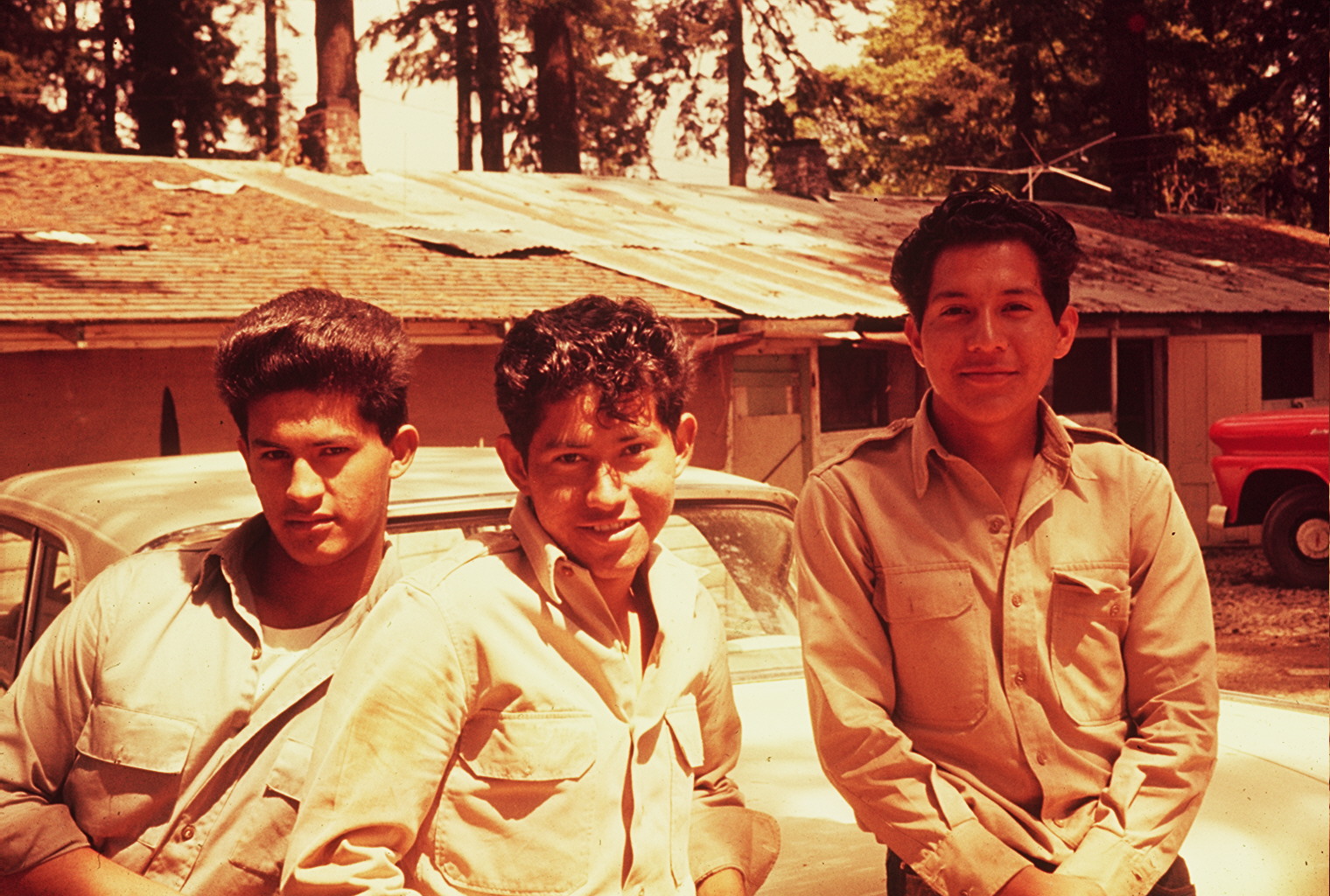
Two men leaned against an old, green car. Dust had dimmed the color of their clothes except for a splotch of red from a squashed strawberry on one man’s shirt.
As I approached the men, I stubbed my toe on a rock and almost dropped the papers and pencils. The men watched . . . wary, puzzled. Were they wondering why a lone woman was entering the camp? Would they accept me as their teacher? If no one came to my class, I would have to report my failure to the Oregon Council of Churches.
“Buenas tardes, good evening.” I spoke in my best Spanish. “I am a teacher of English.”
One man raised himself from the fender of the old car. Three others sauntered across the hard-packed, dirt clearing. “What did she say?”
“She says she is maestra, a teacher of English.”
“Would you like to learn English?” I continued in Spanish.
“Dónde, where do you teach?”
“Here in your camp.”
“When?”
“Right now.”
A little girl and three boys crowded close to hear what I was saying. The tiny, barefooted girl touched a flower in the print of my dress. I smiled at her.
More men came. I was surrounded and I began to feel uneasy. Where were the women? Why didn’t they come to talk to me? The only answer was the warm, brown smell of boiling pinto beans and newly-made flour tortillas that drifted out from the rooms.
One of the men was saying, “Los niños, the children. Is this a school for the children?”
“No,” I explained, “just for adults. Is there a room where we can meet?”
A man spoke softly, “I am called Domingo. We can meet in my room, number thirty-five.” I could see serious, dark eyes under the brim of his straw-colored sombrero.
The word spread and within half an hour room thirty-five was jammed with students. Old men, young men, old women, young mothers with babies. They brought wooden benches to sit on, and they sat on the beds. When the places on the benches and beds were full, they leaned against the rough, unpainted walls, and late corners put their heads in the doorway.
“Here we are teacher,” said Domingo, “We need to learn English. Teach us, please.”
I laid my papers and pencils on the table and stood facing the door. The one bulb hanging from a cord in the center of the ceiling gave little light. I looked at the bare walls and wished for a blackboard.
Already warmed by the summer heat and the cook stove, the room was growing hotter with nearly twenty-five students gathered inside it.
I took a deep breath, “My name is Lois.”
Blank stares.
“Lo-ez,” someone tried to pronounce my name.
Mental note number one: Find a translation for my name before the next meeting.
I had spent hours preparing the lessons. Since no English books were appropriate, I had written the lessons and had them duplicated. Now I passed out the papers.
I hadn’t planned on such a large class so I was short of papers. It didn’t matter. Some students held the papers upside down, some sideways. Most of the class were illiterate.
Mental note number two: Teach the lessons orally. No papers necessary
A baby started to cry.
I wiped the sweat off my forehead with the back of my left hand. “No importa, not important the papers. We will have the lesson without them.”
I cleared my throat. “Repeat after me. This is a window.” I said it first in Spanish and before I could say it in English, they repeated it in Spanish.
“Please always repeat in English. Now, ready? I will point to the window. This is a window.”
I pointed to the wall, but there was no window.
“No importa the window,” I said. “Repeat after me. This is a door.” I pointed to the doorway.
“No is a door, teacher,” said Domingo. “Is Renaldo, Elias, and Juan standing in the doorway.”
Before we finished laughing, I made mental note number three: replan all lessons.
I had much to learn.
The class lasted for an hour. After I promised to return the next evening, I drove to the closest small town. The Council of Churches had arranged for me to stay at the parsonage of the Presbyterian Church.
The minister’s, wife greeted me at the door, “How was your class at the migrant camp?” She led me to the patio and handed me a glass of lemonade.
I sank into a chair. “The lessons were all wrong. I hope I can write some that will be helpful to my students, but I wonder if my Spanish is good enough to make explanations. May I borrow a hoe and a shovel and a bucket? What if the migrants don’t like me and no one continues in the class?”
I spent the next day writing lessons.
The second evening when I arrived at the camp, a little girl ran ahead of me. “Maestra viene, the teacher comes.”
Tired farm workers crowded into room thirty-five.
“Good evening,” I said. “My name is Luisa.”
My students smiled at me. “Good evening, Luisa.”
Instead of bringing papers and pencils, I had struggled into the room with the props that I had borrowed.
I held up a hoe.
“Please repeat after me in English. This is a hoe . . . This is a shovel . . . This is a bucket.”
They repeated in English.
I was beginning to learn.
* * *
Copyright 2012, Rolf Erickson