Missionary to the Migrants
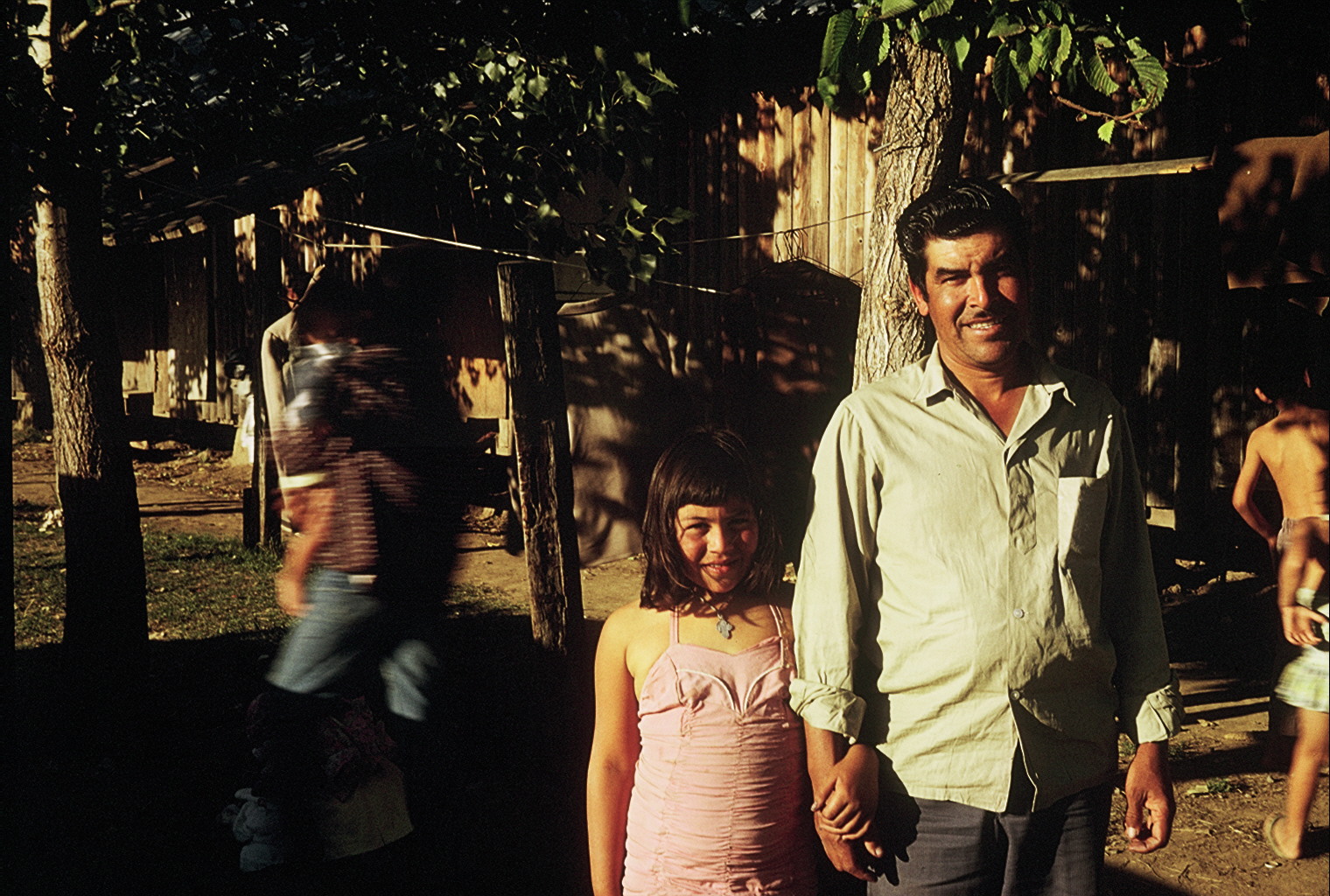
“Porqué? Why?” Domingo asked. “Why do you want to teach us?”
He sat on a bench outside the door to his room. Delia, one of his younger daughters, came to stand near him and he put his arm around her. Domingo was a slender man. I noticed lines in his face and a few grey hairs in his trim mustache.
“Because I like the people,” I answered.
Domingo’s wife Rosalia came to the door with a dish of boiled pinto beans and a flour tortilla, hot from the stove.
“Luisa, will you eat?”
“Yes, thank you.”
I followed Rosalia into the room where I had been teaching English during the last hour. She placed the beans and tortilla on a corner of the table and pulled a bench toward it. From a suitcase she took a large, hand crocheted doily and spread it on the bench so I would have a clean place to sit.
Rosalia stirred the pot of beans on the stove before she came to the table. With quick strokes of a steel rolling pin she formed another flour tortilla. I watched her take it to the stove and put it on the hot cast iron.
She was a short woman, not even as high as my shoulder when we stood. She turned the tortilla over with her hand and then brought it, lightly browned on each side, for me to eat.
“Whatever the reason you are here,” she said, “we are glad.”
Later that night as I was getting ready for bed in the guest room of the Presbyterian parsonage, I considered Domingo’s question, “Why do you want to teach us?” What strong force motivated me to go to a migrant camp to teach English?
As a teenager I had considered becoming a missionary. I imagined traveling to an exotic land, bringing joyful hope to heathens and outcasts.
Then I met Ken, and interest in faraway missionary efforts faded. After we graduated from college, Ken and I were married, and now we had three children.
But somewhere the dormant missionary zeal was still lurking. The potential was part of me, and I also had not lost interest in traveling to a foreign country. I had no desire to leave Ken and the children to bring hope to Africa or India, but a week or two of travel was a welcome idea.
Since Mexico was the closest possibility, I enrolled in an adult education Spanish class. I thought that Spanish was my goal, but it turned out to be the passport to a new dimension in my life.
“Just teach me a few phrases,” I told the Spanish teacher. “I don’t want to bother with all those verb tenses.”
He smiled and continued to teach verbs along with phrases until I was completely fascinated with the language.
I became an eager student in the class, but I needed more practice than the two hours a week. I was always on the alert for an opportunity to use what I had learned. Dictionary in hand I asked my question, “Do you speak Spanish?” to anyone whose hair was slightly darker than my light brown.
One evening my husband Ken and I attended a concert at the Civic Auditorium. During intermission I heard a handsome, dark-haired man speaking in Spanish with two elegantly dressed women. Before Ken could grab my arm to hold me back, I had dashed to the side of the man and entered the conversation.
In my best Spanish I intended to say, “I love the Spanish language,” but my best was not good enough. I said, “I love a Spaniard.”
Three faces turned to me and I realized my sentence was not correct. Remembering my manners as well as my Spanish lesson, I started again.
“Good evening, ladies and sir. Your language enchants me.”
Graciously the man presented his wife and the wife of a visiting diplomat from Peru. Then he introduced himself, “I am the Mexican consul.”
I reported each attempt at conversation to my patient teacher. “But I can’t depend on these chance meetings. I need more practice.”
“You could pick strawberries,” he said.
“Strawberries! I don’t want to pick strawberries.”
“You’ll find Spanish-speaking people in the fields.”
“Who are they?”
“Migrant workers from Texas and Arizona.”
“But would I have to pick strawberries? One year I picked enough for our family and I remember how my back ached after a couple of hours in the field.”
“No. You could wait until bean season and pick
beans.”
“I don’t want to pick beans. There must be some other way to get to know the workers.”
At last I found a way to meet them. The Migrant Ministry of the Oregon Council of Churches offered a program of friendship to migrants, and they needed an English teacher. When I volunteered for the next summer, I became a missionary to the migrants.
The first time that I stepped into a migrant labor camp, I had no idea of the adventures I would find, nor the range of emotions that would grip me over the years to come.
* * *
Copyright 2012, Rolf Erickson